+ Contact the Vocation Office to learn more about life as a monk at St. Vincent Archabbey 724.532.6655 +

July 2, 2013

Four Men Preparing for Novitiate!


St. Vincent Welcomes Four New Postulants

From Left to Right: Edwin Camello (from Lakewook, CA), Mark Liatti (Auburn, AL), Matthew Hershey (State College, PA), Ed Hopkins (Fort Worth, TX)

In Chapter 58 of his Holy Rule, St. Benedict tells his monks not to grant easy entry to the newcomers of monastic life.  Rather, "The concern must be whether the novice truly seeks God".  

For the next eight days, these men will be spending their time in prayer, preparing to enter into a year long novitiate.  On the morning of July 10, Edwin, Mark, Matthew and Ed will each receive their new religious name, the monastic habit, The Rule of St. Benedict, and holy tonsure.


June 18, 2013

Junior Summer Conference 2013


Junior Summer Conference is an annual gathering of Benedictine Monks in simple profession from around the country for a two week conference. Juniors spend the time in fellowship with other simply professed monks as well as attended various conferences on topics of monastic life, benedictine spirituality, and scripture and liturgical studies. This year Br. Miguel Gonzalez O.S.B. and Br. Rafael Quesada O.S.B. joined six other juniors at Mount Angel Abbey in St. Benedict, Oregon. 


 Fr. Vincent O.S.B. (Prior, Mount Angel Abbey),
 Br. TimothyMcMillan O.S.B. & Br. Luke Turner O.S.B. (St. Benedict Abbey, Atchison, KS)


 Br. Albrecht Nyce O.S.B. (Glastonbury Abbey, Hingham, MA)


Br. Andre O.S.B. (Mount Angel Abbey) Br. TimothyMcMillan O.S.B. & Br. Luke Turner O.S.B. (St. Benedict Abbey, Atchison, KS), Br. Miguel Gonzalez O.S.B. & Br. Rafael Quesada O.S.B. (St. Vincent Archabbey)

Br. David Freeman O.S.B. (St. Bede Abbey, Peru IL) 

Br. Rafael Quesada O.S.B. (St Vincent Archabbey)


June 7, 2013

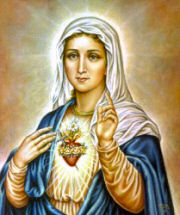
The Feast of the Immaculate Heart of Mary


In the midst of the second world war Pope Pius XII put the whole world under the special protection of our Savior's Mother by consecrating it to her Immaculate Heart, and in 1944 he decreed that in the future the whole Church should celebrate the feast of the Immaculate Heart of Mary. This is not a new devotion. In the seventeenth century, St. John Eudes preached it together with that of the Sacred Heart; in the nineteenth century, Pius VII and Pius IX allowed several churches to celebrate a feast of the Pure Heart of Mary. Pius XII instituted today's feast of the Immaculate Heart of Mary for the whole Church, so as to obtain by her intercession "peace among nations, freedom for the Church, the conversion of sinners, the love of purity and the practice of virtue" (Decree of May 4, 1944).
Historically today is the feast of  St. John Regis, who was ordained into the Society of Jesus in 1630. He was gifted with a marvelous talent for missions, he labored for the conversion of the Huguenots, assisted the needy, and aided in the rescue of wayward women. Also the historical feast of St, Benno who labored to convert the Slavs, established numerous religious edifices, and is said to have founded the cathedral of Meissen.

Immaculate Heart of Mary 
The attention of Christians was early attracted by the love and virtues of the Heart of Mary. The Gospel itself invited this attention with exquisite discretion and delicacy. What was first excited was compassion for the Virgin Mother. It was, so to speak, at the foot of the Cross that the Christian heart first made the acquaintance of the Heart of Mary. Simeon's prophecy paved the way and furnished the devotion with one of its favourite formulae and most popular representations: the heart pierced with a sword. But Mary was not merely passive at the foot of the Cross; "she cooperated through charity", as St. Augustine says, "in the work of our redemption".
It is only in the twelfth, or towards the end of the eleventh century, that slight indications of a regular devotion are perceived in a sermon by St. Bernard (De duodecim stellis).
Stronger evidences are discernible in the pious meditations on the Ave Maria and the Salve Regina, usually attributed either to St. Anselm of Lucca (d. 1080) or St. Bernard; and also in the large book De laudibus B. Mariae Virginis (Douai, 1625) by Richard de Saint-Laurent.
In St. Mechtilde (d. 1298) and St. Gertrude (d. 1302) the devotion had two earnest adherents. A little earlier it had been included by St. Thomas Becket in the devotion to the joys and sorrows of Mary, by Blessed Hermann (d.1245), one of the first spiritual children of St. Dominic, in his other devotions to Mary, and somewhat later it appeared in St. Bridget's Book of Revelations.
St. Ambrose perceived in her the model of a virginal soul. St. Bernardine of Siena (d.1444) was more absorbed in the contemplation of the virginal heart, and it is from him that the Church has borrowed the lessons of the Second Nocturn for the feast of the Heart of Mary. St. Francis de Sales speaks of the perfections of this heart, the model of love for God, and dedicated to it his Theotimus.
In the second half of the sixteenth century and the first half of the seventeenth, ascetic authors dwelt upon this devotion at greater length. It was, however, reserved to St. Jean Eudes (d. 1681) to propagate the devotion, to make it public, and to have a feast celebrated in honor of the Heart of Mary, first at Autun in 1648 and afterwards in a number of French dioceses.
In 1799 Pius VI, then in captivity at Florence, granted the Bishop of Palermo the feast of the Most Pure Heart of Mary for some of the churches in his diocese. In 1805 Pius VII made a new concession, thanks to which the feast was soon widely observed. Such was the existing condition when a twofold movement, started in Paris, gave fresh impetus to the devotion. The two factors of this movement were first of all the revelation of the "miraculous medal" in 1830 and all the prodigies that followed, and then the establishment at Notre-Dame-des-Victoires of the Archconfraternity of the Immaculate Heart of Mary, Refuge of Sinners, which spread rapidly throughout the world and was the source of numberless graces. On 21 July 1855, the Congregation of Rites finally approved the Office and Mass of the Most Pure Heart of Mary without, however, imposing them upon the Universal Church.
Excerpted from Catholic Encyclopedia, 1913 edition.

Solemnity of the Most Sacred Heart of Jesus

The first feast of the Sacred Heart was celebrated on August 31, 1670, in Rennes, France, through the efforts of Fr. Jean Eudes (1602-1680). From Rennes, the devotion spread, but it took the visions of St. Margaret Mary Alacoque (1647-1690) for the devotion to become universal.
In all of these visions, in which Jesus appeared to St. Margaret Mary, the Sacred Heart of Jesus played a central role. The "great apparition," which took place on June 16, 1675, during the octave of the Feast of Corpus Christi, is the source of the modern Feast of the Sacred Heart. In that vision, Christ asked St. Margaret Mary to request that the Feast of the Sacred Heart be celebrated on the Friday after the octave (or eighth day) of the Feast of Corpus Christi, in reparation for the ingratitude of men for the sacrifice that Christ had made for them. The Sacred Heart of Jesus represents not simply His physical heart but His love for all mankind.
The devotion became quite popular after St. Margaret Mary's death in 1690, but, because the Church initially had doubts about the validity of St. Margaret Mary's visions, it wasn't until 1765 that the feast was celebrated officially in France. Almost 100 years later, in 1856, Pope Pius IX, at the request of the French bishops, extended the feast to the universal Church. It is celebrated on the day requested by our Lord-the Friday after the octave of Corpus Christi, or 19 days after Pentecost Sunday.

June 5, 2013

Saint Norbert


Norbert is deservedly numbered by historians among those who made an effective contribution to the reform movement under Pope Gregory VII. He established a clergy dedicated to the ideals of the Gospel and the apostolic Church. They were chaste and poor. They wore “the clothing and the symbols of the new man; that is to say, they wore the religious habit and exhibited the dignity proper to the priesthood.” Norbert asked them “to live according to the norms of the Scriptures with Christ as their model.” They were “to be clean in all natters pertaining to the altar and divine worship, to correct their faults and failings in their chapter meeting, and to care for and give shelter to the poor.”
The priests lived in community, where they continued the work of the apostles. Inspired by the practice of the early Church, Norbert exhorted the faithful to join the monastic life in some capacity. So many men and women responded to the invitation that many asserted that no man since the apostles themselves had inspired so many to embrace the monastic life.
When Norbert was appointed an archbishop, he urged his brothers to carry the faith to the lands of the Wends. In his own diocese he tried unsuccessfully to convince the clergy of the need for reform and was confronted with noisy protests both in the street and in the church.
One of the principal goals of Norbert’s life was to foster harmony between the Apostolic See and the German empire. At the same time he wanted to maintain Rome’s freedom in the matter of ecclesiastical appointments. Apparently his efforts were so successful that Pope Innocent II thanked him profusely in a letter in which he called him a “devoted son,” and Lothair made him chancellor of the realm.
Norbert did all these things with a steadfast faith: “Faith was the outstanding virtue of Norbert’s life, as charity had been the hallmark of Bernard of Clairvaux’.” Affable and charming, amiable to one and all, “he was at ease in the company of the humble and the great alike.” Finally, he was a most eloquent preacher; after long meditation “he would preach the word of God” and with his fiery eloquence purged vices, refined virtues and filled souls of good will with the warmth of wisdom.” He spent many hours in contemplation of the divine mysteries and fearlessly spread the spiritual insights which were the fruit of his meditation.
Source: The Liturgy of the Hours – Office of Readings

Pax et Gaudium

O.S.B. Vocation Awareness

O.S.B. Vocation Awareness